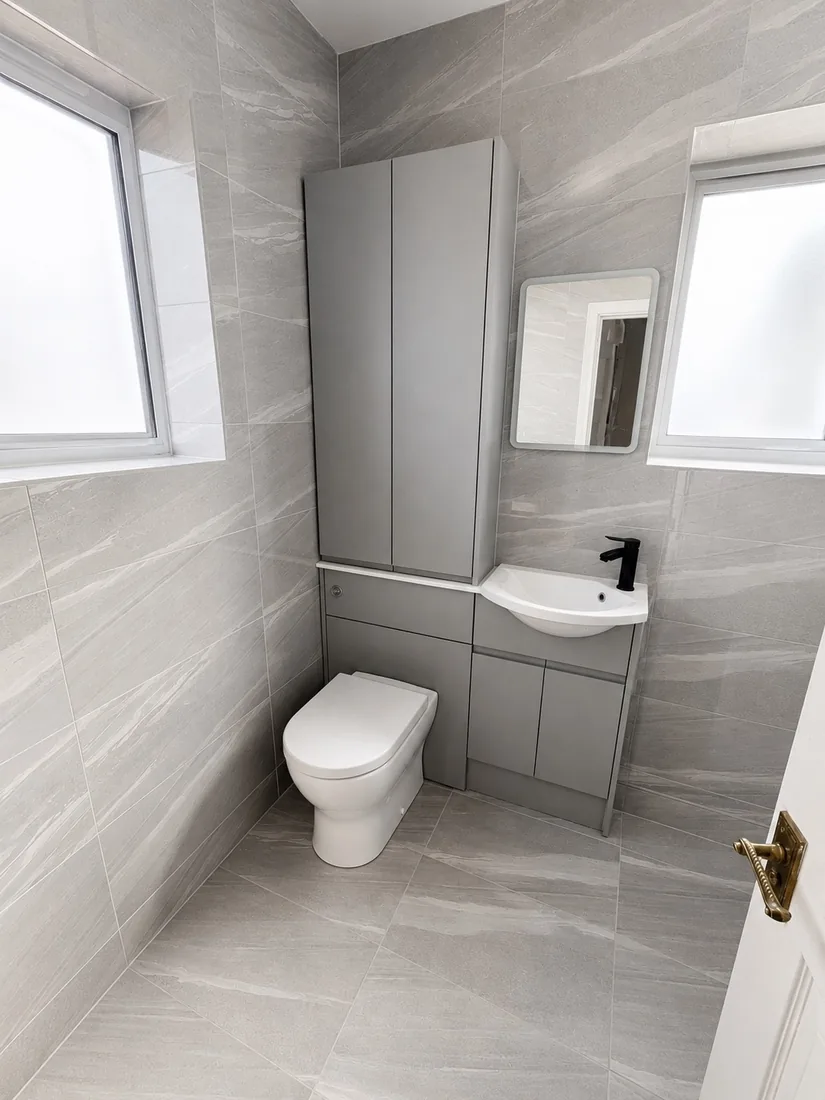
Trace the cause
We identify whether the damp is penetrating, rising or condensation before specifying any cure — no covering over.
Coastal and period homes ask more of a bathroom than a modern build does. Solid walls, lath-and-plaster, damp, salt-laden air and uneven floors are all part of the picture along the West Sussex seafront — and getting them right is the difference between a bathroom that lasts and one that disappoints by its second winter.

A great deal of bathroom advice online is written for new, cavity-walled houses with dry, square rooms. That is not the housing stock we mostly work in. The Victorian and Edwardian terraces, the older conversions and the seafront flats and houses along the West Sussex coast were built differently, behave differently, and need to be approached on their own terms.
Two things in particular catch people out: the construction is often solid wall rather than cavity, frequently finished in original lath-and-plaster; and the environment is salty and humid. Both have real, practical consequences for how a bathroom should be built and what it should be built from. Treat a period coastal bathroom like a modern one and you tend to get damp, corroded fittings and finishes that fail early. Treat it on its own terms and you get a room that looks right for the house and lasts.
A solid wall has no cavity — no air gap to interrupt moisture passing from outside to in, and nowhere for trapped damp to escape sideways. That changes the whole approach to waterproofing. The instinct to seal a wet room up tight can actually make matters worse on a solid wall, because moisture that finds its way in then has nowhere to go and sits in the masonry. The better discipline is a proper waterproof barrier exactly where it is needed — the wet zones — combined with breathability and ventilation everywhere else, so the wall can dry rather than rot.
Original lath-and-plaster is part of what gives a period home its character, but it is also fragile, often uneven, and not always a sound base for heavy tiling. We assess it honestly at survey: sometimes it is sound and can stay, sometimes failing sections are best overboarded with a suitable waterproof backing board to give tiling a stable, flat substrate. The aim is to keep what is genuinely worth keeping while giving new finishes something dependable to sit on.
Period rooms are rarely level or square. Floors slope, joists flex, and walls lean. None of this is a problem when it is planned for — floors can be levelled or strengthened, large-format tiles chosen or avoided to suit the surface, and fittings set out so the finished room reads straight even when the structure isn't. It is the difference between a fit-out that fights the building and one that works with it. Our bathroom renovation approach is built around keeping what is sound and putting right what isn't.
By the sea, the details you can't see — the fixings, the tanking, the extraction — decide how long the bathroom you can see actually lasts.
Damp is the single most common issue we expect to meet in coastal and period bathrooms, and the most commonly mistreated. The first job is always to work out which damp you are dealing with, because the cures are different. Penetrating damp comes through the structure from outside. Rising damp climbs from the ground. Condensation — by far the most frequent in bathrooms — is warm, moist air settling on cold surfaces. Painting over the symptom, or sealing the room tighter, simply moves the problem somewhere you can't see it.
We identify whether the damp is penetrating, rising or condensation before specifying any cure — no covering over.
A continuous waterproof layer behind the tiles in the shower and bath areas keeps water in the room and out of the wall.
Outside the wet zones, breathable finishes and good ventilation let solid walls dry rather than trapping moisture.
This is where a coastal bathroom rewards proper tanking. Forming a continuous waterproof membrane across the wet zones, behind the tiles, is what keeps water out of solid masonry that has no cavity to protect it. Done properly at the build stage, it is invisible and permanent. Done badly, or skipped, it is the cause of most of the failures we are called to put right.
Living by the sea is one of the joys of the West Sussex coast, but salt-laden air is unkind to metal. It accelerates corrosion, and in a room that is also warm and humid the effect is amplified. Lower-grade chrome plating, budget radiators and the cheap zinc fixings hidden inside a build can pit, spot and flake years before they would inland. The visible taps are only half the story — the brackets, screws and fixings holding everything in place are just as exposed and matter just as much.
The answer is sensible specification rather than anything exotic. Better-grade stainless steel, solid brass and quality chromed brassware hold up far better than budget plated alternatives. Corrosion-resistant fixings throughout — not just where they show — keep the whole installation sound. None of this needs to be wildly expensive; it needs to be chosen with the environment in mind. Pair good materials with good tiling and stonework and the room is built to cope with where it lives.
Fittings that sit in damp, still air corrode faster. So extraction is not only about the building fabric — it protects the brassware and radiators too. A bathroom that clears its moisture quickly keeps its fittings looking good for longer, which is why we treat ventilation as a core part of any coastal specification, not an afterthought.
If there is one thing that protects a period coastal bathroom more than any other, it is moving moist air out of the room before it can do harm. Period homes were never built airtight, and their solid walls and original plaster cope badly with trapped moisture. A bathroom generates a great deal of warm, wet air, and without an effective route out, that moisture condenses on cold walls and feeds mould, peeling paint and timber decay.
In a period property this is not an optional upgrade. It is what protects the fabric of the building and the finish you have just invested in.
The best period bathrooms look entirely at home in the house and behave like a thoroughly modern room. There is no contradiction in that — the trick is to make the period character the visible layer and the modern performance the hidden one. Traditional-style suites, heritage brassware, panelling and classic tiling sit perfectly happily over modern tanking, concealed cisterns, thermostatic showers, underfloor heating and proper extraction.
Working sympathetically with original features — restoring rather than ripping out where it makes sense, matching proportions and detailing to the age of the property — is what keeps a renovation feeling like it belongs. Underneath, the room gets every modern advantage: reliable waterproofing, efficient heating, strong ventilation and dependable plumbing. If you would like to picture a scheme before committing, our 3D concept generator lets you preview a look in your own room first.
Coastal & period homes we cover:
Period and coastal work carries a few extra considerations that a standard new-build bathroom does not: putting right damp, stabilising or overboarding old plaster, specifying corrosion-resistant materials and fitting proper extraction all take time and good materials. As a rough guide, full bathroom projects in the UK commonly fall somewhere in the region of £6,000 to £15,000 or more depending on size, spec and how much remedial work the room needs — but those are general industry ranges, not our set prices, and period properties vary enormously.
The only honest way to price this kind of work is to look at the actual room. We survey the property, identify what is sound and what needs putting right, and give you a clear, fixed written quote for the work — no guesswork and no surprises tiled over later. When you are ready, you can register your interest and we will arrange a survey.
It pays to choose with the sea in mind. Within a bathroom by the coast, the air is more humid and carries more salt, so we lean towards better-grade stainless steel, solid brass and quality chromed brassware over cheap plated fittings that pit and flake early. Hidden fixings, brackets and screws matter just as much as the visible taps — using corrosion-resistant fixings throughout is what keeps a fit-out looking sharp years down the line. The fittings don't have to be exotic or expensive, just well chosen for the environment.
Solid (non-cavity) walls have no air gap to stop moisture passing through, so the answer is rarely to seal everything tight. We trace damp to its cause first — penetrating damp, condensation or a failed seal are all different problems with different cures. The wet zones around the shower and bath are tanked to form a continuous waterproof layer behind the tiles, while the room as a whole is kept ventilated and, where appropriate, finished with breathable materials so the wall can still dry. Trapping moisture behind an impervious finish is what causes most of the damage we see.
Period homes were not built airtight, and their solid walls and original plaster cope badly with trapped moisture. A bathroom produces a lot of warm, wet air, and without somewhere for it to go that moisture condenses on cold walls and feeds mould, peeling paint and rot. Proper extraction — a correctly sized, well-ducted fan vented to the outside, ideally on a humidity sensor or run-on timer — clears that moist air at source. In a period property good ventilation is not an optional extra; it is what protects the fabric of the building and the finish you have just paid for.
Yes, and it is one of the most rewarding things to get right. Traditional-style suites, heritage brassware, panelling and classic tiling sit perfectly happily over modern waterproofing, concealed cisterns, thermostatic showers, underfloor heating and proper extraction. The trick is to make the period character the visible layer and the modern performance the hidden one, so the room looks right for the house but behaves like a current bathroom. We are happy to work sympathetically with original features rather than stripping them out.
It genuinely does, and it is one of the things owners further inland never have to think about. Salt-laden coastal air accelerates corrosion, so lower-grade chrome plating, cheap fixings and budget radiators can pit, spot and flake far sooner than they would elsewhere. It is most noticeable on poorly specified items in rooms that also stay humid. Choosing corrosion-resistant materials, ventilating properly so fittings are not sitting in damp air, and avoiding the cheapest plated metals is what keeps a coastal bathroom looking good for the long term.
More practical guidance from Barrington Interiors on planning and finishing a bathroom in West Sussex:
We open for bookings in June 2027 — join the 2027 priority list now, and founding clients get first pick of the calendar.